What the site allows, written down once
An order now keeps one versioned sheet of what the site allows, each line with who stated it and where from. The people who know answer in the order, and a design is checked against one version of it.
 Nordform editorial · 5 min read
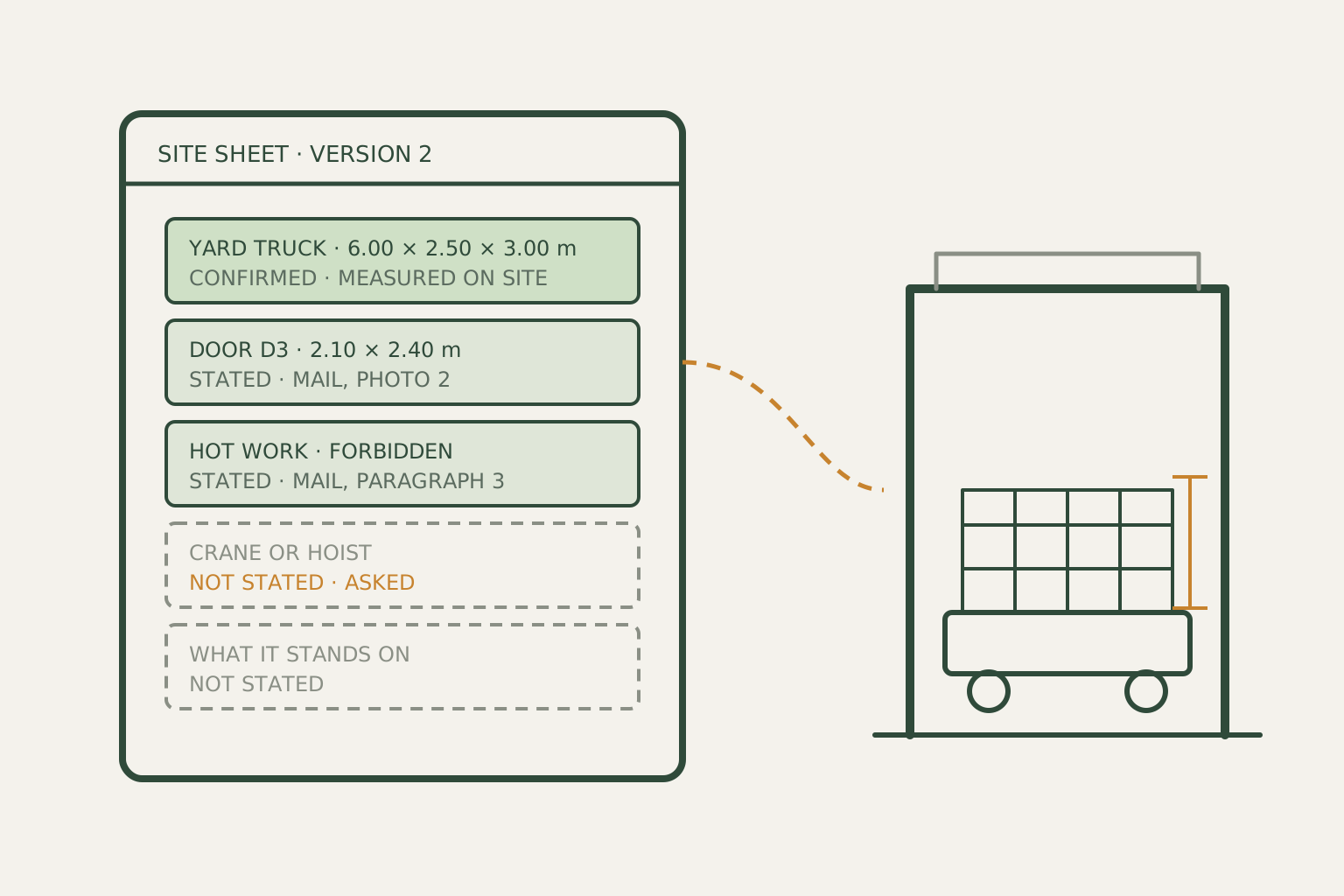
A supplier's design is built into somebody else's site. The platform has to come in on the trucks that site allows, pass its doors, be lifted by whatever lifts there, and be joined the way its hot-work rules allow. Those facts usually arrive as a paragraph in one mail, a photo in another and a remark on a call. They are rarely in one place, and rarely in front of the person drawing the pieces.
An order now has a site sheet for them.
One record, line by line
The site sheet sits in the order's Site view. It has a line for each thing the site decides: transport into the site, each opening on the route, what lifts on site, hot work, what the work stands on, the plant's rules, and the layout the design sits in.
Each line is one of two things. Either it is stated, with who stated it and where it came from (a mail, a photo, a drawing page), or it is not stated, and the sheet says so. No line has a default. A blank is never filled in with a typical value, because a typical door is not the door on this route.
The supplier's project manager starts the sheet. Every saved change is a new version, and earlier versions stay readable, so it is always possible to see what was known when a design was checked.
From a mail, in its own words
Most of this arrives by mail, so a mail to the order can be read into a proposed version. The reading must use the mail's own words and numbers: "yard trucks only, max 6 m" can become a transport line of 6 m, with the paragraph it came from as its source. A sentence that gives no value stays a sentence, not a guess. The project manager adopts the proposal whole or discards it. Attachments are not read yet.
Asking the party who knows
For a line nobody has stated, the project manager can send the customer's layout engineer or project manager a drafted question (the customer here being the equipment maker who placed the order). The question waits on that person in the order like any other open item, and it closes when a version states the line.
They can also answer in the order itself. The customer's people confirm a line as stated, correct it, or answer a line nobody stated, and each time they say how they know: measured on site, read from a drawing, or estimated. Each answer is a new version under their name. A line that someone else stated or confirmed stays theirs to change.
A design checked against one version
An access platform can be checked against one version of the sheet:
- Transport. Every piece fits the stated truck.
- Openings. Every piece passes each opening on the route, and one that passes with little to spare is flagged so the opening can be confirmed.
- Site joints. Site joints are made the way the hot-work rule allows. Where the design does not state its joints, the check says it cannot tell, rather than passing.
- Lifting. The heaviest piece is within the stated lifting. Today the pieces carry no masses, so this check asks for them.
- Fixing. What the work stands on is stated. Base fixings are not chosen here.
The pieces are cut by our own rule, which every result states: posts and braces ship loose, and each other assembly ships whole.
When a newer version of the sheet is saved, the design is run again with its own inputs unchanged. It shows which checks moved, and the designer chooses whether to update to the new version or keep the one it was checked against.
You can see this without signing in. The access structures demo has a Site chapter: a sample sheet, the saved platform cut into pieces, and a second version in which the yard trucks turn out to take 6 m instead of 5.
Scope
- This screens a concept. It is not an installation plan, a lifting plan or a hot-work permit, and it approves nothing.
- Only access platforms are checked against a sheet, and only by our own cut into pieces. A model from the access engine is not checked yet.
- The customer's layout engineer or project manager answers in the order the supplier invited them to. The plant owner cannot yet answer, directly or through them.
- The mail reading is held to the mail's words in code, and has not yet been measured on a set of real order mails.
- Mail attachments are not read, and a re-run tells the order and the design, not each person's inbox.
- The order screens are in English.