Nordform Group
When AI joins the design team
AI can now draft a model, redraw a sheet or propose a change in minutes. That changes how a design team plans its work, reviews it and keeps its people skilled. This page sets out what we think has to change, and what Nordform does about it today.
What changes
In most design offices the slow part has been producing the work: modelling, drawing, rechecking. When software does much of that, the slow part moves to people:
- Review becomes the bottleneck. An agent can produce ten options in the time it takes to look properly at one. Nobody can sign what they have not had time to read.
- Authorship gets blurred. If a change came from a prompt, someone still has to own the decision to keep it.
- Context gets lost faster. More versions, more options and more comments in more places make it harder to know which version a remark was about.
- Skills can quietly fade. If people only approve work they no longer do themselves, their ability to spot a wrong answer weakens over time.
None of this is a reason to keep AI out. The work still needs designers and engineers, and the way the team works needs to change around them.
Record how the work was done, as well as the result
We work to four rules:
- Every change is a version. A proposal from an agent and an edit by a person both land as a saved version you can name, compare and return to. Nothing changes a design silently.
- An agent proposes; people decide. The agent's output is a typed proposal. Deterministic code builds the geometry from it, and a person accepts it, asks for another, or rejects it.
- Give each piece of work a scope. Say what the job is, who is responsible, which inputs are missing and what has to be delivered. An agent working without a scope produces more to review, not less.
- Write the decision down where it was made. What was decided, by whom and on which version, kept beside the design rather than in an inbox.
Collaborate on one record
When AI produces part of the work, people need a shared place where they can see what was produced, what was checked and what is still open:
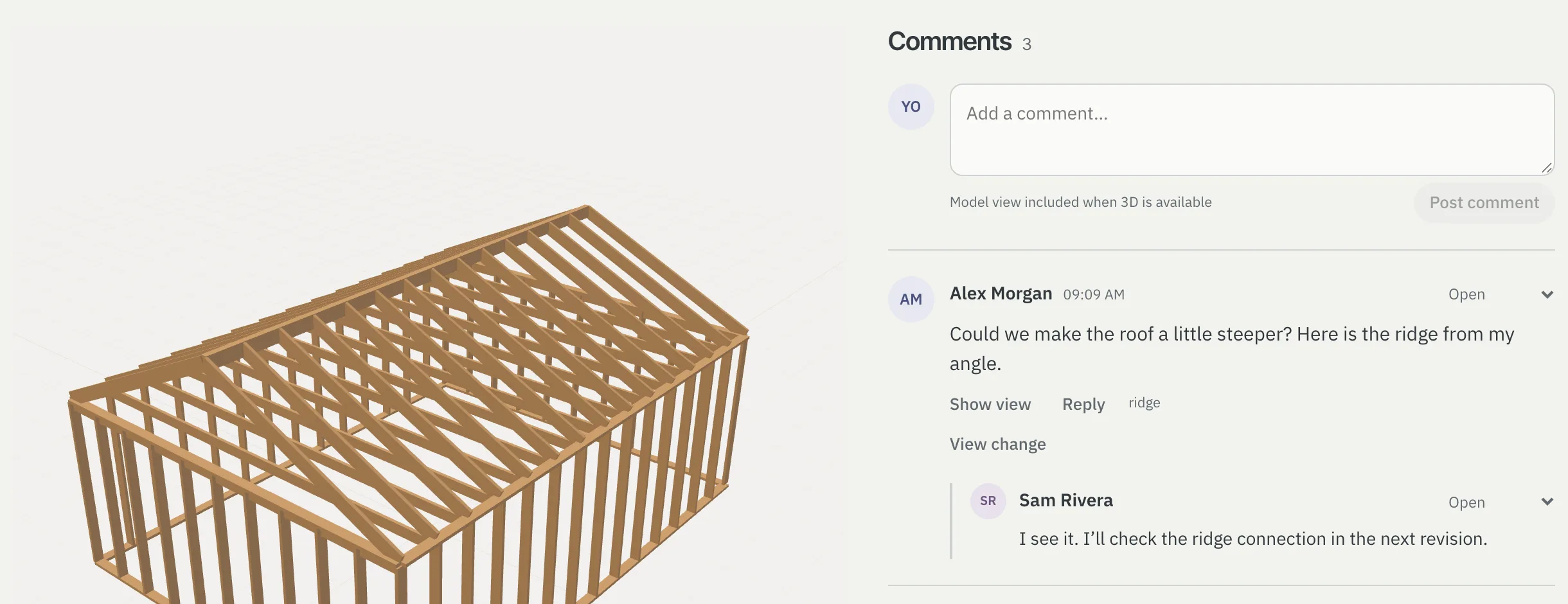
- Comments belong to a version. A remark about version 3 stays with version 3 when version 4 arrives, so nobody answers a question about a design that has already changed.
- Everyone sees who is in the design. Colleagues and invited reviewers can see who has a design open and which version they hold.
- Review has a named reviewer and a named question. A colleague's comment, an expert's scoped review and an approval are three different things, and the record keeps them apart.
- The handoff carries its evidence. The next person gets the current version, the checks that ran on it, the decisions made and what is still unresolved.
Keep the skills in the team
Engineering judgment is learned by doing the work and by seeing why a design is right or wrong. If AI takes over the doing, the team has to protect the learning on purpose:
- Write down the rules your people use. The frames, spans, details and limits your engineers apply become explicit rules that the software follows and that a newer colleague can read. We write that kit with you, and you decide what it is allowed to produce.
- Every check names the rule it read. A result shows which rule, which inputs and which version it used, so a person can follow the reasoning instead of trusting a green tick.
- People sign, and they sign one version. A qualified person reviews the result and puts their name on that exact version, with its limitations stated. Approval always comes from a person.
- Keep people doing real checks. Use the time AI saves on review, explanation and mentoring, not only on more output.
What Nordform does today
- Saves every settled change, by a person or by the agent, as a version.
- Keeps conversation, decisions, comments and check results on the version they belong to, in one design record.
- Shows who has a design open, and gives a company workspace members, roles and assigned work packages. See Team and presence.
- Shares one version with a reviewer for a set time, and records a scoped expert review separately from comments. See Review and sharing.
- Runs checks that record the rule, the inputs and the version they read.
Working together
- Members of a shared personal project see each other's pointers, selections and the version they are on, live. On a company design, two saves that change different parts are both kept as successive versions; when both change the same part to different values, the second person chooses which to keep.
- Keeping a team's judgment sharp is a practice the team runs. The record makes the reasoning visible to everyone on it.
- Permits, certification and readiness to build are decided by the people responsible for them.
Explore the product · How we work · For engineers · Where it breaks