What the registers say, before an ecologist walks the site
The Site tool in Nordform Pro now reads the public nature registers that cover a site and drafts the field surveys an ecologist would plan, each with its season and its reason. The fieldwork stays with the ecologist.
 Nordform editorial · 4 min read
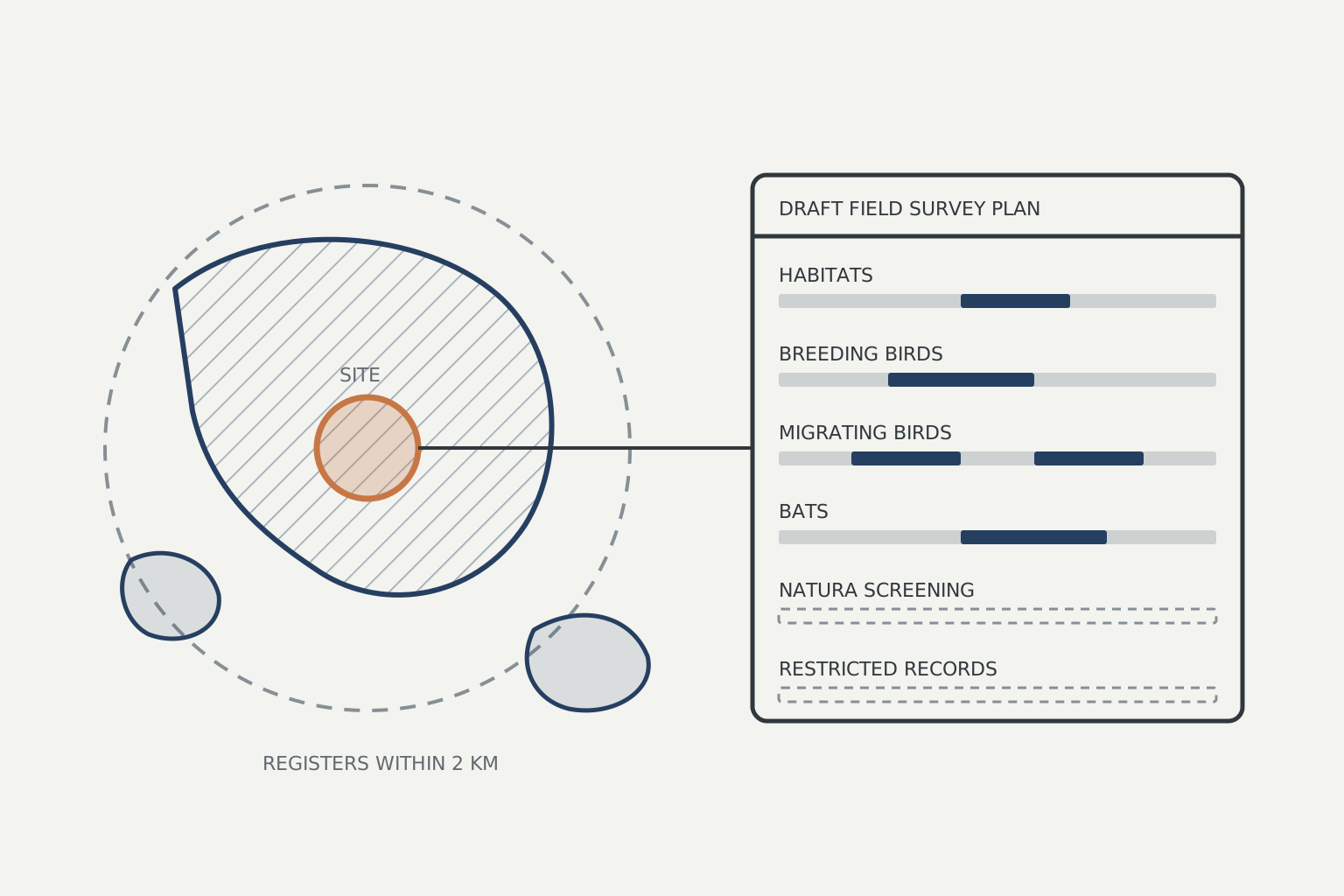
A solar park, a wind farm or a substation needs to know what lives on its land before the permit. Finding out is fieldwork: a qualified ecologist on site, at the right time of year, often across more than one season. Nothing here replaces that.
Around the fieldwork sits desk work. Someone collects what public registers already hold about the site, decides which surveys it needs and books them before their season passes. The Site tool in Nordform Pro now does a first draft of that work.
What the registers say
In the Site tool's evidence panel, Read nature registers reads the public registers that cover the site's country:
- Species records from GBIF, the Global Biodiversity Information Facility: counts by group (birds, bats, amphibians, insects, plants and more), and the species nearby that are on the IUCN global Red List.
- Natura 2000 sites from the European Environment Agency's register, across the EU.
- In Finland, from the Finnish Environment Institute (Syke): nature reserves on state and private land, wilderness areas, groundwater areas and the mapped 1-in-100-year flood zones.
Each registered area is listed with its distance from the site, and with the share of the site it covers when it reaches it. A register that does not cover the country is listed as not covering it. A register that does not answer is listed as failed. Neither is ever shown as an empty site.
The reading keeps three things apart: what the registers say, what that might mean (a Natura 2000 site nearby usually means the authority expects a Natura assessment screening), and what only an ecologist or the authority can settle.
A draft list of surveys
From the reading and the project use, the tool drafts the surveys an ecologist would plan, each with its method, its usual season and the reason it is there. For a wind farm at the edge of Nuuksio, west of Helsinki, that is ten items. Among them are migrating birds, because turbines are a collision risk on migration routes, and a Natura assessment screening, because the site lies inside the Nuuksio Natura 2000 site. A solar park in the same place drops only the raptor survey: migrating birds stay because the Natura site is designated for birds, and bats stay because bats have been recorded nearby.
The months are the usual windows between 45° and 72° north. Elsewhere the ecologist sets them.
Kept with the rest of the evidence
Keep as evidence source saves the reading and its plan to the project's files and adds it to the evidence register as an ecology source. It can then be the source of an exclusion area, and it goes into the investigation brief. Some species records carry non-commercial licences, so a reviewer decides in the register whether the brief may leave the project.
You can see this without signing in. The nature registers demo shows three sites as the Site tool reads them: at the edge of Nuuksio in Finland, north of Madrid and in west Texas, with the plan for each kind of project.
Scope
- This is a desk study, not a nature survey. An ecologist confirms, adjusts and signs the plan, and the authority decides what the permit needs.
- In Pro, a site can be placed only in Finland today. The lookups behind it already read Natura 2000 across the EU and species records worldwide; placing sites in other countries comes next.
- Public registers hide or coarsen the locations of sensitive species. Ask the national species data centre for restricted records before planning fieldwork.
- Red-list categories are the IUCN global list, checked for each species. National red lists are not read yet.
- Outside the EU and Finland, no protected-area register is read yet. A site there shows species records only, and says so.
- Records include planted, cultivated and escaped organisms as well as wild ones. The ecologist judges which describe the site.