An answer should name what it rests on
Help answers in the Studio now name the guide section they rest on, a house rule can start as a sentence, every concept says what it was checked against, and a drawing finding says what kind it is. What changed, and where it stops.
 Nordform editorial · 5 min read
A model can draft an answer, a rule or a list of findings in seconds. That is not what makes it usable in engineering work. What matters is whether a person can see what it rests on, correct it, and tell who accepted it. This week six parts of the Studio started to say so.
A help answer names its guide section
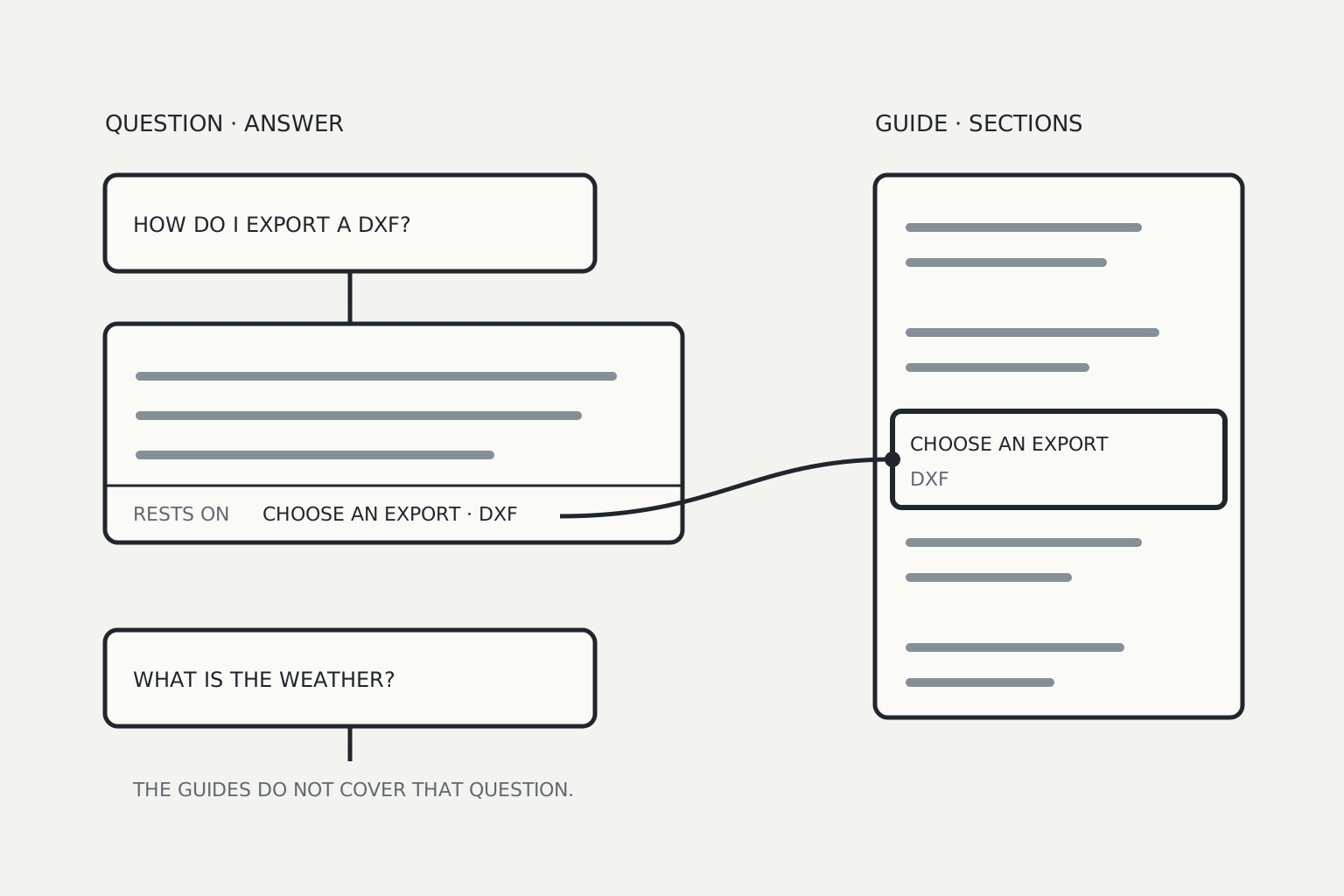
The help page in the Studio now has a box called Ask the guides. You ask a question in your own words, and the answer is drafted only from the sections of the guides that match it. Under the answer, a Rests on line names the section, and the name opens the guide at that place. If you ask about one of your projects, the answer may also rest on that project's latest saved version, and it says so.
Choosing which sections to hand the model is done by plain word matching, not by a model. When no section matches well enough, you get one sentence: the guides do not cover that question. No model is asked, and the question does not count against the 40 answers each account has per day.
We test that matching against 47 questions written the way an engineer would ask them. Today 41 reach the right section, or correctly reach none. We keep the six that miss as findings about the guide, rather than rewording them until they pass.
A house rule starts as a sentence
A company administrator can now write a house rule in words, such as a minimum clearance the company always keeps. The model proposes it in the typed form the company's rulesets already use, with its test, its figure and the facts it reads. The administrator corrects the figure and records who read the rule in which document and clause. Then they see what the rule would say about each of the company's saved designs, before anything is published.
Publishing goes through the same path as an uploaded ruleset, and a published version never changes. The model never publishes. A rule nobody has marked as seen in its document publishes as a draft that counts for nothing.
Every concept says what it was checked against
When the Studio compares concepts for a steel portal frame, or for a tank in its Concepts tab, each option now carries two lines. Checked against lists the checks, the rule keys and the country package versions it ran with. Not checked lists what no rule covered. Two options are only comparable when they were checked against the same thing. When every option shares one basis, the panel says so once. When they differ, it lists each option's basis.
A drawing finding says what kind it is
The drawing check now names each finding as one of three kinds. A discrepancy is two readings of the drawing that disagree. Missing information is a value the sheet should carry and does not. A scope gap is a part or sheet the set names and does not contain. The result counts each kind.
Scope gaps can only be judged when the whole set is known, and no rule judges them yet. The result says "not judged" instead of showing a zero, because a zero would read as a clean result.
Two revisions of a drawing set, sheet by sheet
You can now choose two revisions of a drawing set and see what changed on each sheet. In a DXF that means lines added, removed or moved, by layer. In a PDF it means text that changed, by page and position. A change is named as a title-block field, a parts-list cell or a dimension where it is one, and Open shows it in place. The comparison says what changed. It does not judge whether the change is right.
What a connected assistant can read
An assistant you connect over MCP can now read the rulesets your administrators have published and the context packs behind the checks. It works from the same house rules and sources the Studio holds a project to. It can also read a saved tank pre-study: the brief, what is still open, the evidence and the concept comparison. It can only read. The decisions in a pre-study are answered, run and signed in the Studio.
Where it stops
- Only the Pro guide answers help questions. The API and support pages are not searched yet.
- The quality of the drafted help answers is not yet measured. The test above covers which sections are chosen.
- A company's first ruleset still comes in as an upload.
- Concept comparison is on the steel portal and the tank. The pipe run is not on it yet, and company rulesets are not yet part of an option's basis.
- The drawing check and the comparison read text and vector geometry. Scanned pages are not read.
- What a company has learned from its own designs is not readable over MCP.
None of these answers, rules or findings is an engineering approval. AI prepares proposals, and permitted engineering tools calculate and check. A named engineer reviews the result and authorises release, and the record keeps who did.